Well... my local SOA or Super (duper) Output Area is known as Redditch 005A apparently [1]. My little area is almost entirely residential, with a very small office area included. There is a nature reserve within our community which is incredibly named the "natural nature reserve". My community also lies close to a bypass known as the Coventry Highway which is closely linked to the M42 by the A435 and is on the sub-urban fringe of my town, right on the edge (Some pictures within the residential area of my community [2] [3].
According to the http://www.Communities.gov.uk under "Definition of a 'Sustainable Community'" they describe it as being a combination of different factors that together, make a community that is good to live in for themselves and for others in the future [4]. They have a list of different elements that can make a sustainable community and further lists that can also define the type of community, so I'll just have to describe my area and see which one (if any) it fits into.
570 houses with 559 of those semi or completely dethatched [5]. According to Communities and Local Government (CLG) a 'well designed and built community' has a wide range of houses... so I guess it’s not that one then... Ok how about religion, 80.42% Christian, and 12.88% with no religion, the 'Active, inclusive and safe' community has a populous that has an engagement and respect with people from other beliefs. So there is no real chance to do that within my community, they would have to go elsewhere for that experience, so not that one either... I'm probably trying to tackle this the wrong way, I know there is a bypass close by with links to the M42, so that fills the category for well connected slightly, I know through personal experience that there aren’t any cycle paths though (sorry Gregg), so I suppose it doesn’t fill all of that criteria.
My area might not be the most 'sustainable' in its social aspect with little cultural diversity, and lack of communicating on a regular basis. It's slightly poor in terms of environment because again, personal experience reminds me that the bus routes are shocking at best and the only links are roads which isn’t the most sustainable long term use of travel. The economic side is the only real factor that is ok for my community with employment above the regional and national standards [6] and the majority of housing higher quality semi/detached houses. But the thought that keeps passing through my mind is that I think, overall, my area functions very well as a community because when problems have risen such as the lack of public transport which actually happened suddenly when the bus routes were completely changed, my community adapted and started using more cars and walked more.
My community I think should come under a new heading of 'adaptive community'. To be sustainable the community need to be a place where "people want to live and work, now and in the future" as said by the CLG themselves. My community has always been like that but has constantly changed since it was built. I would say it’s more of a 'well connected' community according to the CLG but who says that what they say is exactly right about what a community should be like, who says what I think a community could be, being 'adaptive', is wrong or right?
1) My Local SOA: http://www.neighbourhood.statistics.gov.uk/dissemination/LeadAreaSearch.do?a=3&r=1&i=1001&m=0&s=1268760784934&enc=1&areaSearchText=B98+0QT&area
SearchType=141&extendedList=false&searchAreas=
2) Picture within Kingscote Close: http://www.geograph.org.uk/photo/29156
3) Picture beside the local Londis Shop in Furze Lane: http://www.geograph.org.uk/photo/29157
4) Communities and Local Government: http://www.communities.gov.uk/archived/general-content/communities/whatis/
Categories
5) Housing: Accommodation Type - Household Spaces (UV56)
6) Work: Key Figures for Work Deprivation
Tuesday, 16 March 2010

Tuesday, 2 March 2010
BP 8 - I've never liked mainstream politics... ever...
So you want to know my home's politics? OK no worries there,
Constituency: Redditch [1]
Local MP: Jacqui Smith, Labour (woop)
Local Council: Redditch Borough Council [2]
Local Council dominated mostly by: Conservatives (...) [3]
To answer the first question about my attitude to those whom don't vote is well... mixed. I think you should vote depending on how you have been influenced by those who are already in "power" (be it positively or negatively ) and the alternatives that are available to you by other parties that are most likely to be seen through... although that isn’t very often that a lot of promises ever go through [4]. This is so that those already with control can be almost made accountable in a way for their actions in charge and should (I say should) influence more into voting for them if they did well for the area, or lose votes respectably if their actions were poor. With the alternatives, I think it should only be right that they be judged on what they are willing to carry through whilst taking into account the implications of carrying out a particular 'promise' over others.
The people who vote that way are fine in my books, it’s just the others... those who attempt to use the vote for other means or only vote for the party focusing the most on a single matter rather than thinking about the bigger picture and otherwise wouldn't vote. One such problem was when BNP managed 2 seats in the EU and the vote for BNP both through protest and because their policies on immigration and related issues were shared by a large number of people but there were no real policies for the economy or other problems the UK is facing. If they don't vote then they don't have a say but if they don't really 'vote' by not voting properly then its counter-productive and could cause more problems than if they didn't vote at all by changing who gets power. It is Deffinatly safer not to vote than to throw it away and vote for anyone or a party you only share a few interests in but not others.
My main concerns would be the extent that the party would share the majority of the countries views on matters and would address problems as experts but with the viewpoint of the people. If they do that, then I have no problems really, even if that view point would not match my own it would match the majority and help more people if corrected for them. It's only fair and it’s only right that such actions would be taken by those in power. I have a few more petty concerns like anything that could negatively effect me as a student, it could potentially have large repercussions further down the line but otherwise I would just have to say it would be for the best... and moan to others around me... maybe start an independent party.
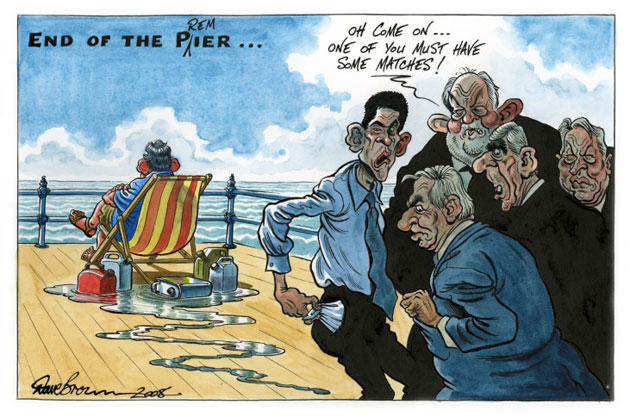
For fun :) http://adamsmith.files.wordpress.com/2008/07/cartoon290708_41106a.jpg
1) General election results 2005/2001/1997 for Redditch: http://www.guardian.co.uk/politics/constituency/1240/redditch
2) Redditch Borough Council main internet page: http://redditch.whub.org.uk/cms/default.aspx
3) Interactive map of the local election results by the guardian, see Worcestershire: http://www.guardian.co.uk/politics/local-election-results-map-2009
4) False promises by parties : http://www.independent.co.uk/opinion/commentators/steve-richards/steve-richards-the-false-promise-of-romantic-ideas-1902771.html
Constituency: Redditch [1]
Local MP: Jacqui Smith, Labour (woop)
Local Council: Redditch Borough Council [2]
Local Council dominated mostly by: Conservatives (...) [3]
To answer the first question about my attitude to those whom don't vote is well... mixed. I think you should vote depending on how you have been influenced by those who are already in "power" (be it positively or negatively ) and the alternatives that are available to you by other parties that are most likely to be seen through... although that isn’t very often that a lot of promises ever go through [4]. This is so that those already with control can be almost made accountable in a way for their actions in charge and should (I say should) influence more into voting for them if they did well for the area, or lose votes respectably if their actions were poor. With the alternatives, I think it should only be right that they be judged on what they are willing to carry through whilst taking into account the implications of carrying out a particular 'promise' over others.
The people who vote that way are fine in my books, it’s just the others... those who attempt to use the vote for other means or only vote for the party focusing the most on a single matter rather than thinking about the bigger picture and otherwise wouldn't vote. One such problem was when BNP managed 2 seats in the EU and the vote for BNP both through protest and because their policies on immigration and related issues were shared by a large number of people but there were no real policies for the economy or other problems the UK is facing. If they don't vote then they don't have a say but if they don't really 'vote' by not voting properly then its counter-productive and could cause more problems than if they didn't vote at all by changing who gets power. It is Deffinatly safer not to vote than to throw it away and vote for anyone or a party you only share a few interests in but not others.
My main concerns would be the extent that the party would share the majority of the countries views on matters and would address problems as experts but with the viewpoint of the people. If they do that, then I have no problems really, even if that view point would not match my own it would match the majority and help more people if corrected for them. It's only fair and it’s only right that such actions would be taken by those in power. I have a few more petty concerns like anything that could negatively effect me as a student, it could potentially have large repercussions further down the line but otherwise I would just have to say it would be for the best... and moan to others around me... maybe start an independent party.
For fun :) http://adamsmith.files.wordpress.com/2008/07/cartoon290708_41106a.jpg
1) General election results 2005/2001/1997 for Redditch: http://www.guardian.co.uk/politics/constituency/1240/redditch
2) Redditch Borough Council main internet page: http://redditch.whub.org.uk/cms/default.aspx
3) Interactive map of the local election results by the guardian, see Worcestershire: http://www.guardian.co.uk/politics/local-election-results-map-2009
4) False promises by parties : http://www.independent.co.uk/opinion/commentators/steve-richards/steve-richards-the-false-promise-of-romantic-ideas-1902771.html
Tuesday, 9 February 2010
BP 6 and 7 - Transport ...
Transport?! It's dire, let’s move on, please?
From personal experience it seems to me that if you mention transport to people, they instantly moan about everything that makes it hell or the immensely long journeys they have to take commuting to and from their work or place of study. Even I tend to try to avoid it sometimes because it’s such a complicated issue. But from where I'm standing, it tends to get people worked up easily about their own issues regarding transport.
My own views on transport vary massively depending on what about transport you want to ask about. I hate public transport but I know it’s the way we will have to go as a functioning economy as it takes us away from high car dependency and all of its problems, health being one of them [1]... Transport is a problem we need to address otherwise it will get out of hand and could come at a time when we might need to focus on other matters... I also think that public transport should be for work and commuting rather than the exceptional journey to transport the majority rather than the minority.
There is Deffinatly a problem with the transport system at the moment. It all lies around the problem of car dependency which most people know about. Lots of data being published at the moment are showing a continual trend of increasing car usage even though it contributes to some of the biggest problems associated with transport [3]. People say they will use public transport if the quality is better, but to improve the services investment and demand has to be high enough, which isn't the case because of the large amount of car usage [4]
I think they do because the environmental and social downsides [5] are relatively small (climate change not included) compared to the dependency of the economy on fast and convenient travel which motorized transport provides. Thinking about climate change then there are far too many variables and unknown answers about the impact of reducing motorized vehicle usage directly to climate change and would need to consider the ever changing results of that phenomena.
However after saying all that, that question should never be spoken again! Ever! It allows people to say yes giving them an escape point so no progress is made over the issue, once they have already decided that the benefits outweigh costs. What we should be saying is do the benefits of other modes of transport outweigh their respective costs greater than that of motorized transport? That way if people say no then at least we know there is no alternative. However if they say yes though then we can look at the alternatives and know more can be done.
Get rid of "car dependency" and increase massively public transport and more environmental ways of transporting people and goods. Easier said than done though right? In an ideal world I’d say do it and they all would, but people have different expectations of public transport, different needs surrounding transport and different ways of adjusting to it all. I think it’s best to continue with micro scale plans where businesses sort out their employees and the councils sort out the bigger plans with roads and actually setting up the transport. Do it slow enough so if something bad does happen then it can quickly undo itself and then try again, otherwise people may wish they hadn't put you in charge.
1) BBC Online news page on Exhaust Emissions: http://news.bbc.co.uk/1/hi/health/medical_notes/336738.stm
2) BBC Search list for problems with Oil dependency: http://search.bbc.co.uk/search?scope=all&tab=all&q=oil+dependency+problem
3) DfT – Roads, vehicles and congestion: http://www.dft.gov.uk/pgr/statistics/datatablespublications/trends/current/section1rvc.pdf
4) Environment City Leicester : http://www.environmentcity.org.uk/article.asp?
5) Cities for Children – The Effects of Car Usage on Their Lives: http://eprints.ucl.ac.uk/1348/
From personal experience it seems to me that if you mention transport to people, they instantly moan about everything that makes it hell or the immensely long journeys they have to take commuting to and from their work or place of study. Even I tend to try to avoid it sometimes because it’s such a complicated issue. But from where I'm standing, it tends to get people worked up easily about their own issues regarding transport.
My own views on transport vary massively depending on what about transport you want to ask about. I hate public transport but I know it’s the way we will have to go as a functioning economy as it takes us away from high car dependency and all of its problems, health being one of them [1]... Transport is a problem we need to address otherwise it will get out of hand and could come at a time when we might need to focus on other matters... I also think that public transport should be for work and commuting rather than the exceptional journey to transport the majority rather than the minority.
There is Deffinatly a problem with the transport system at the moment. It all lies around the problem of car dependency which most people know about. Lots of data being published at the moment are showing a continual trend of increasing car usage even though it contributes to some of the biggest problems associated with transport [3]. People say they will use public transport if the quality is better, but to improve the services investment and demand has to be high enough, which isn't the case because of the large amount of car usage [4]
I think they do because the environmental and social downsides [5] are relatively small (climate change not included) compared to the dependency of the economy on fast and convenient travel which motorized transport provides. Thinking about climate change then there are far too many variables and unknown answers about the impact of reducing motorized vehicle usage directly to climate change and would need to consider the ever changing results of that phenomena.
However after saying all that, that question should never be spoken again! Ever! It allows people to say yes giving them an escape point so no progress is made over the issue, once they have already decided that the benefits outweigh costs. What we should be saying is do the benefits of other modes of transport outweigh their respective costs greater than that of motorized transport? That way if people say no then at least we know there is no alternative. However if they say yes though then we can look at the alternatives and know more can be done.
Get rid of "car dependency" and increase massively public transport and more environmental ways of transporting people and goods. Easier said than done though right? In an ideal world I’d say do it and they all would, but people have different expectations of public transport, different needs surrounding transport and different ways of adjusting to it all. I think it’s best to continue with micro scale plans where businesses sort out their employees and the councils sort out the bigger plans with roads and actually setting up the transport. Do it slow enough so if something bad does happen then it can quickly undo itself and then try again, otherwise people may wish they hadn't put you in charge.
1) BBC Online news page on Exhaust Emissions: http://news.bbc.co.uk/1/hi/health/medical_notes/336738.stm
2) BBC Search list for problems with Oil dependency: http://search.bbc.co.uk/search?scope=all&tab=all&q=oil+dependency+problem
3) DfT – Roads, vehicles and congestion: http://www.dft.gov.uk/pgr/statistics/datatablespublications/trends/current/section1rvc.pdf
4) Environment City Leicester : http://www.environmentcity.org.uk/article.asp?
5) Cities for Children – The Effects of Car Usage on Their Lives: http://eprints.ucl.ac.uk/1348/
Subscribe to:
Comments (Atom)